SOLUTIONS
Respiratory Changes Often Come Before Obvious Signs
Reliable respiratory information can help clinicians recognize meaningful changes earlier across the continuum of care.1,2
Capnography in Procedural Sedation and Beyond
During procedural sedation, patients are at increased risk of respiratory compromise that may not be immediately apparent.1 While this risk is most closely associated with sedation, respiratory changes can also occur during recovery and routine monitoring—often before obvious signs appear.
That's why early recognition depends on timely, reliable respiratory information.1,2
Continuous Respiratory Insight Across Care Settings
Capnography plays a critical role during procedural sedation by providing continuous insight into ventilation when patients are most vulnerable.1 This same visibility can be extended into recovery and beyond, helping clinicians track respiratory status and identify meaningful changes earlier across a variety of care settings.1-3
With reliable EtCO2 monitoring, clinicians can better assess:1,2
- Quality of ventilation
- Early signs of airway obstruction
- Respiratory rate trends and variability
- Subtle changes in respiratory status that may precede detectable oxygen desaturation
Confident Respiratory Assessment Depends on More Than Measurement Alone
A respiratory measurement provides only part of the picture.
Clinicians also rely on a clear, interpretable waveform to assess respiratory status and recognize meaningful changes in patient condition.4
Reliable Monitoring Starts With Reliable Sampling
Sidestream capnography depends on consistent gas sampling.
Moisture and supplemental oxygen delivery can affect waveform quality and EtCO2 performance, making reliable sampling critical for confident respiratory assessment.5
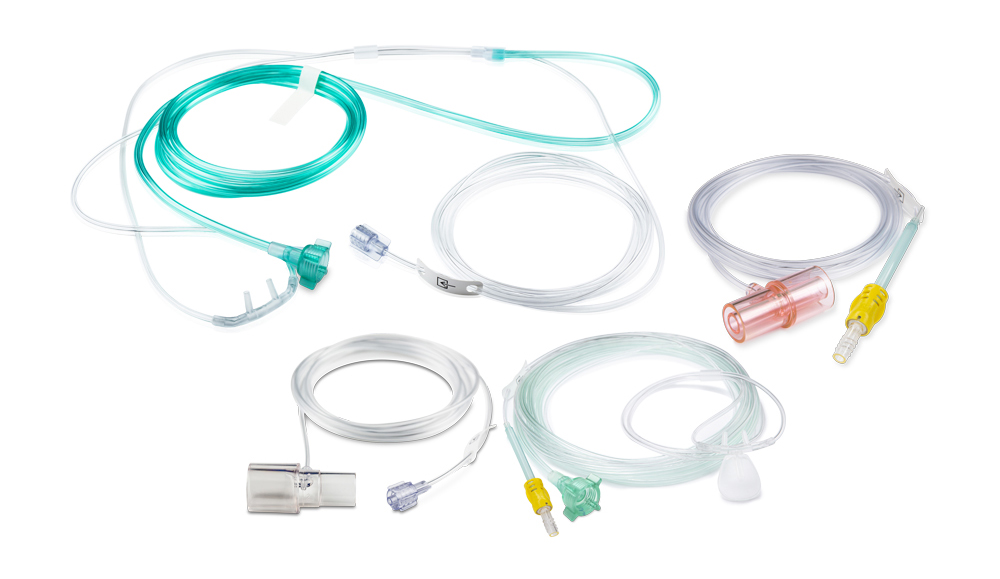
NomoLine-O® Sampling Lines are designed to deliver consistent, moisture-free gas sampling across diverse clinical settings while maintaining patient comfort during longer monitoring periods.
Why Waveform Quality Matters
A reliable EtCO2 waveform delivers clear, breath-by-breath insight into respiratory patterns.
Reducing extra noise and unclear signals helps make it easier to recognize real changes and assess breathing with greater confidence.4
Why Cannula Design Can Make a Difference
Clinical evidence shows that split-flow/separate-prong cannulas can help support reliable EtCO2 waveform integrity during high O2 flow and effective oxygen delivery compared with other cannula designs.6
NomoLine-O Supports Confident Real-World Monitoring
| Monitoring Challenge | How NomoLine-O ® Supports Confidence |
|---|---|
| Moisture/Condensation | Moisture-wicking technology supports moisture-free gas sampling, reducing monitoring interruptions and simplifying workflows. |
| Waveform Quality/Dropout | Split-flow cannula supports reliable EtCO2 performance and waveform integrity. |
| Supplemental O2 Delivery | Split-flow design is intended to reduce gas mixing and support accurate EtCO2 sampling and adequate O2 delivery. |
| Patient Tolerance | Lightweight, soft materials are designed for patient comfort and extended monitoring. |
| Analyzer Protection | Hydrophobic bacterial filter helps protect the gas analyzer. |
Confidence Across Care Settings
From procedural sedation to recovery and routine monitoring, NomoLine® capnography solutions support respiratory assessment across a variety of care settings.
Explore solutions for intubated and non-intubated patients, including NomoLine-O sampling lines designed to support reliable gas sampling during extended monitoring.
Emergency Nurses Association (ENA). Capnography during procedural sedation/analgesia: Clinical practice guideline. Emergency Nurses Association; 2024.
Donnelly Hellings S, Fuller J, Maillie S. End-tidal CO₂ monitoring. American Nurse Journal. 2024.
Chung F, Wong J, Mestek ML et al. Characterization of respiratory compromise and the potential clinical utility of capnography in the post-anesthesia care unit: a blinded observational trial. J Clin Monit Comput. 2019;34(3):541–551.
Kodali BS, Urman RD. Capnography during cardiopulmonary resuscitation: current evidence and future directions. J Emerg Trauma Shock. 2014;7(4):332–340.
Philips Healthcare. Capnography clinical considerations: technical and clinical factors affecting EtCO₂ monitoring. 2017
Ebert TJ, Novalija J et al. The effectiveness of oxygen delivery and reliability of carbon dioxide waveforms: a crossover comparison of 4 nasal cannulae. Anesth Analg. 2015 Feb;120(2):342-8.
Caution: Federal (USA) law restricts this device to sale by or on the order of a physician. See instructions for use for full prescribing information, including indications, contraindications, warnings, and precautions.
PLCO-008205/PLM-15525A-0726